Self Assessment Tax Return
Support with preparing and submitting your tax return
Self Assessment is the system HM Revenue & Customs (HMRC) uses to collect Income Tax from people whose tax is not fully dealt with through PAYE.
IPA Bookkeeping & Accounting Ltd can help you organise your financial information, prepare your year-end accounts where required, complete your Self Assessment tax return and submit it to HMRC after you have reviewed and approved it.
Who may need to submit a Self Assessment tax return?
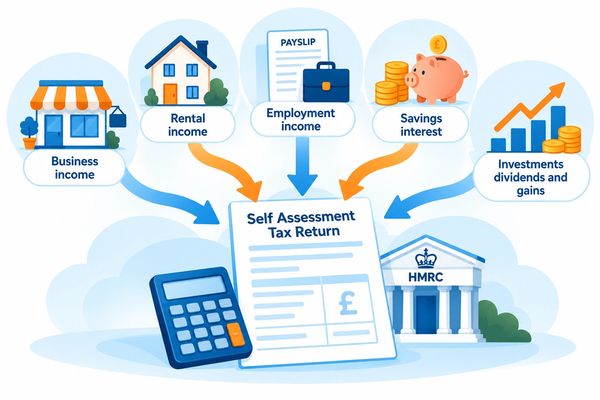
You may need to complete a tax return if, during the tax year, you:
- worked as a sole trader and received more than £1,000 in gross trading income;
- were a partner in a business partnership;
- received income from renting out property;
- had savings, investment, dividend or overseas income that must be reported;
- made a taxable capital gain;
- received other income on which tax has not been paid;
- need to claim certain expenses or tax reliefs; or
- have been asked by HMRC to submit a tax return.
The rules depend on your individual circumstances. If you are unsure, we can review the information you provide and help you identify the appropriate next step. HMRC also provides an online checker.

Registering for Self Assessment
If you need to submit a tax return and have not previously registered, you will normally need to tell HMRC by 5 October following the end of the relevant tax year.
For example, if you need to submit a return for the 2025/26 tax year, which ended on 5 April 2026, you would normally need to register by 5 October 2026.
You may also need to reactivate your Self Assessment account if you previously submitted tax returns but HMRC later told you that you did not need to file one.
We can explain what information is required and help you through the registration process..

What information will we need?
The information required will depend on your circumstances, but may include:
- your Unique Taxpayer Reference (UTR);
- your National Insurance number;
- “Confirmation of whether you are already registered for Self Assessment.”
- your previous Self Assessment tax return;
- HMRC correspondence, including notices to file and tax calculations;
- business income and expense records;
- invoices, receipts and bank statements;
- property rental income and expenses;
- employment details and P60 or P45 forms;
- pension statements;
- CIS deduction statements;
- savings interest and dividend information;
- details of benefits received;
- pension contributions and Gift Aid donations;
- student loan information;
- Capital Gains Tax information; and
- details of any other taxable income or relevant tax reliefs.
We will provide a tailored information request so that you know what is needed for your return.
Your bookkeeping and year-end accounts
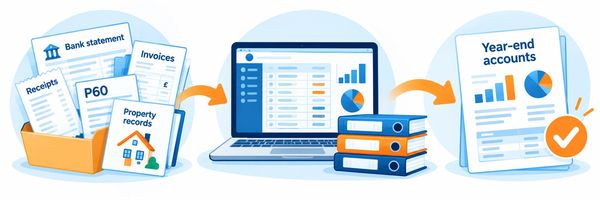
Where your Self Assessment includes income from self-employment or property, we may need to complete or review the relevant bookkeeping before preparing the tax return.
We will:
- review the records you provide;
- identify missing or unclear information;
- organise and reconcile the transactions where this is included in our service;
- prepare the relevant year-end figures; and
- use the completed figures when preparing your tax return.
If your records are incomplete, behind or disorganised, additional catch-up or clean-up bookkeeping may be required before the return can be completed.
We identify questions as we work
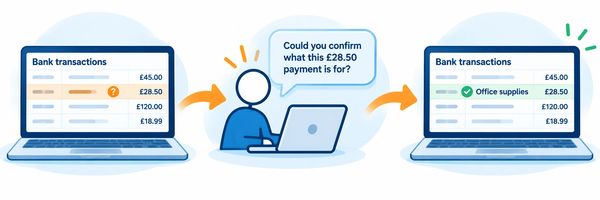
Sometimes a transaction cannot be classified correctly without additional information from you.
We may ask about:
- payments with unclear descriptions;
- money transferred between accounts;
- possible personal expenditure;
- cash income or expenses;
- missing invoices or receipts;
- business use of personal accounts;
- property-related expenditure; or
- changes in your personal or business circumstances.
Answering questions promptly helps us prepare your return accurately and avoid unnecessary delays..
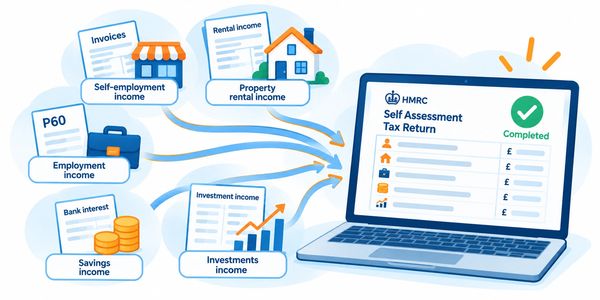
We prepare your Self Assessment tax return
Once we have the necessary records and information, we will prepare your Self Assessment tax return using the figures and details you have provided.
Depending on your circumstances, this may include:
- self-employment income;
- partnership income;
- UK property income;
- employment and benefits;
- pensions;
- savings interest;
- dividends;
- foreign income;
- student loan repayments;
- Capital Gains Tax information; and
- relevant allowances, expenses and tax reliefs.
We will only complete sections that fall within the agreed scope of our service. More complex matters may require specialist tax advice.
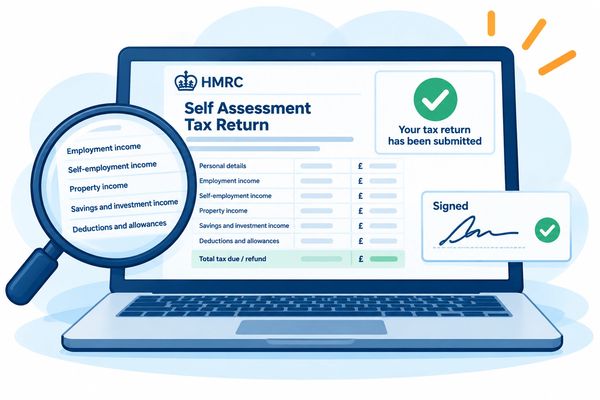
You review and approve the return
Before submitting your tax return, we will provide the completed return or an appropriate summary for you to review.
You must:
- check that your personal information is correct;
- review the income, expenses and other figures;
- tell us if anything is missing or inaccurate;
- ask questions if you do not understand something; and
- confirm that you approve the return for submission.
Although we prepare the return using the information provided, you remain legally responsible for ensuring that the return is complete and correct.
We will not submit your return until we have received your approval.
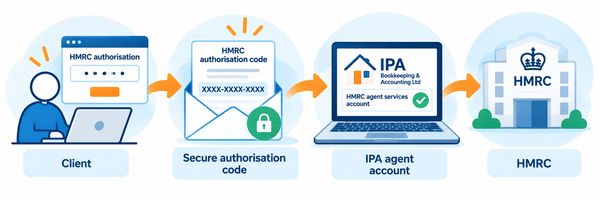
Authorising us to act for you
Before we can deal with HMRC on your behalf for Self Assessment, you will need to authorise IPA Bookkeeping & Accounting Ltd as your tax agent.
We will normally start the authorisation request with HMRC. HMRC will then send an authorisation code to you by post. When you receive the letter, please send the code to us promptly so we can complete the authorisation before it expires.
You should never send us your Government Gateway user ID, password, sign-in or two-step verification codes. We use our own HMRC agent credentials when acting for you.
Once authorised, we can deal with HMRC and submit your Self Assessment Tax Return on your behalf.
You remain legally responsible for your tax affairs and must check and approve your Self Assessment tax return before we submit it to HMRC.
Submission deadlines
We may set an earlier internal deadline for receiving your complete records. This gives us sufficient time to review the information, ask questions and prepare your return properly.
Understanding your tax calculation
After preparing your return, we will explain the calculation produced using the information available.
Your amount payable may include:
- Income Tax;
- National Insurance contributions;
- student loan or postgraduate loan repayments;
- a balancing payment for the completed tax year;
- payments on account towards the following tax year;
- Capital Gains Tax, where applicable; or
- interest or penalties already charged by HMRC.
The figures shown are based on the information provided and HMRC’s rules at the time the return is prepared.What's a product or service you'd like to show.
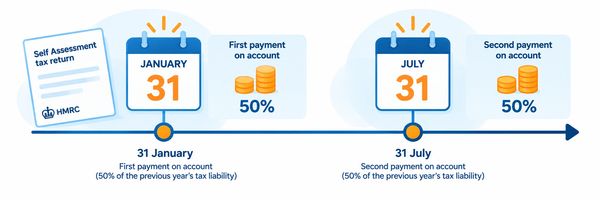
Payments on account
Payments on account are advance payments towards your next Self Assessment tax bill. They are normally required if your previous year’s relevant tax liability was £1,000 or more and less than 80% of your total tax liability was collected outside Self Assessment, for example through PAYE.
Two payments are usually required, each calculated as half of the previous year’s relevant tax liability. They are due on 31 January and 31 July. Payments on account do not normally include amounts such as Capital Gains Tax or student loan repayments.
This can make the amount due on 31 January larger than expected because it may include both:
- the balancing payment for the tax year just completed; and
- the first payment on account towards the following tax year.
We will explain the calculation shown on your return so that you understand what is due and can prepare for the payment deadlines.
Paying HMRC remains your responsibility
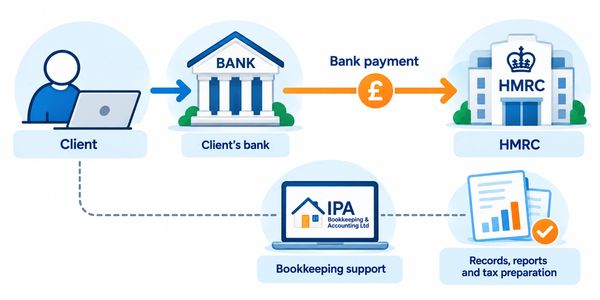
IPA Bookkeeping & Accounting Ltd does not receive, hold or make tax payments on behalf of clients.
You are responsible for:
- checking how much is payable;
- ensuring HMRC has the correct payment reference;
- making payments directly to HMRC;
- allowing sufficient time for the payment to reach HMRC; and
- checking that HMRC has allocated the payment correctly.
We can explain the amount and deadline shown in the available information, but the payment must be made by you.
Why completing your return early can help
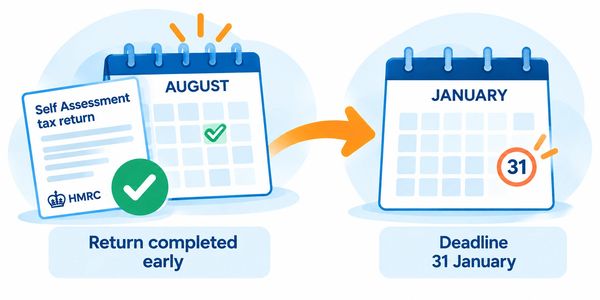
You do not need to wait until January to complete your tax return. A return can normally be prepared after the tax year has ended and the necessary information is available.
Completing it earlier can give you:
- more time to find missing records;
- time to answer questions without last-minute pressure;
- earlier confirmation of the amount payable;
- more time to budget for the tax bill;
- an opportunity to correct issues before the deadline; and
- more time to contact HMRC if you may have difficulty paying.
Submitting early does not normally mean that the tax must be paid early—the standard payment deadline still applies.
Late returns and payments
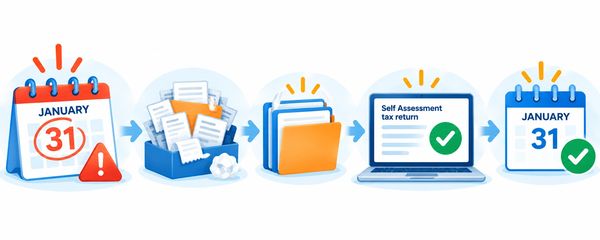
Submitting a tax return or paying the tax after the applicable deadline may result in penalties and interest.
The penalty rules that apply can depend on the tax year and whether you are required to use Making Tax Digital for Income Tax. HMRC is introducing a points-based penalty system for late submissions for taxpayers brought within Making Tax Digital for Income Tax.
If your return is already overdue, it is usually important to deal with it as soon as possible rather than allowing further delays to build up.
If you contact us about an overdue return, we can help establish what information is needed and what work must be completed before the return can be prepared.
Making Tax Digital for Income Tax
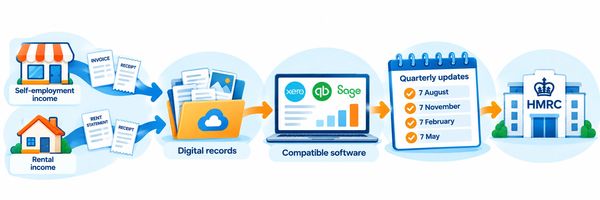
Making Tax Digital for Income Tax is changing how some sole traders and landlords keep records and report information to HMRC.
Depending on your qualifying income and circumstances, you may be required to use Making Tax Digital for Income Tax. This includes keeping digital records, using compatible software, sending quarterly updates to HMRC and completing your tax return through compatible software.

Behind with your Self Assessment?
If you have missed a deadline, have several outstanding tax returns or do not know where to begin, please tell us what has happened.
We can help by:
- identifying which returns may be outstanding;
- reviewing the records currently available;
- explaining what additional information is needed;
- completing catch-up bookkeeping or year-end accounts where agreed;
- preparing the outstanding return or returns; and
- helping you understand the figures and next steps.
The earlier we receive complete information, the sooner we can begin putting the records and returns in order.
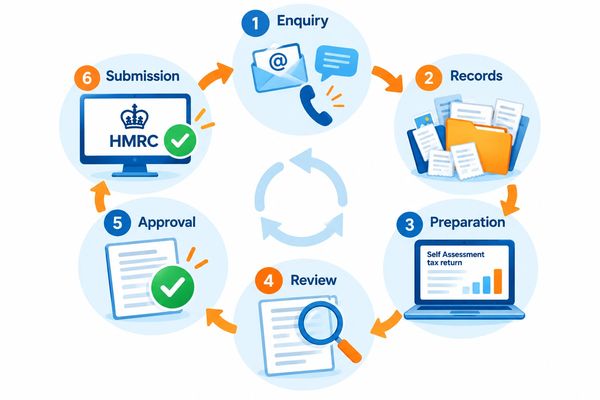
How our Self Assessment service works
- Initial enquiry — You tell us about your income, circumstances and the tax year involved.
- Scope and quotation — We explain what work is required and provide a quotation.
- Onboarding — We complete the required identity, anti-money-laundering and client acceptance checks.
- Agent authorisation — You authorise us to act for you with HMRC, where required.
- Information request — We provide a tailored list of the records and documents needed.
- Bookkeeping and accounts — We complete any agreed bookkeeping or year-end work.
- Tax return preparation — We prepare the return using the information provided.
- Questions and review — We resolve queries and send the return to you for checking.
- Your approval — You confirm that the return is complete and approve its submission.
- Submission — We submit the approved return to HMRC and provide confirmation.
- Payment information — We explain the amount and deadline shown, but you pay HMRC directly.