How Our Catch-Up Bookkeeping Service Works

Have your bookkeeping records fallen behind?
Running a business takes time, and keeping the bookkeeping up to date can sometimes move to the bottom of the list. A few busy weeks can quickly become a few months, receipts and invoices start to build up, transactions remain unreconciled and, before you know it, there is a backlog to deal with.
You don't need to sort everything out before contacting IPA.
Our Catch-Up Bookkeeping service is designed for businesses whose bookkeeping has fallen behind and needs to be brought back up to date.
We start by understanding where your bookkeeping currently stands, what records and information are available, how far behind things have become and what needs to be completed. From there, we can agree a practical way forward and work through the outstanding bookkeeping step by step.
Once your records are up to date, we can also help you establish a more regular bookkeeping routine to make it easier to stay on top of things going forward.

What is Catch-Up Bookkeeping?
Catch-Up Bookkeeping is about completing bookkeeping that should already have been done but hasn’t yet been processed.
For example, you may have several weeks or months of bank transactions that haven’t been recorded or reconciled, receipts and invoices waiting to be processed, or accounting software that simply hasn’t been updated for some time.
We will establish where your bookkeeping currently stands, identify the period that needs to be brought up to date and agree what information we need from you.
We can then work through the outstanding bookkeeping systematically until your records are brought up to the agreed current position. This may include:
- entering outstanding sales and purchase transactions;
- processing receipts, invoices and other supporting documents;
- bringing bank and credit card records up to date;
- completing outstanding bank reconciliations;
- checking for missing information;
- reviewing balances for anything that needs further investigation; and
- preparing the records for VAT Returns, year-end accounts or Self Assessment, where applicable.
The work required will depend on how far behind the records are and the information currently available.

Is Catch-Up Bookkeeping Right for You?
Catch-up bookkeeping may be appropriate if:
- you have not updated your bookkeeping for several weeks or months;
- transactions are waiting to be entered into your accounting software;
- bank accounts have not been reconciled;
- receipts and invoices have accumulated;
- you need to bring your records up to date before a VAT, year-end or Self Assessment deadline;
- you started bookkeeping but did not have time to continue;
- your accountant has asked you to provide completed bookkeeping records; or
- you want to restart regular bookkeeping from an accurate, up-to-date position.
If transactions have already been entered but the records contain errors, duplicates or incorrect balances, our Bookkeeping Clean-Up Service may be more appropriate. In some cases, both catch-up and clean-up work may be required.

Catch-Up or Clean-Up — what's the difference?
The two services are related, but they solve different problems.
Catch-Up Bookkeeping is primarily for bookkeeping that hasn't been completed yet. There may be weeks or months of transactions, receipts or invoices waiting to be processed.
Clean-Up Bookkeeping is for records that have already been entered or processed but need reviewing and correcting because they may be inaccurate, duplicated, incorrectly categorised, unreconciled or otherwise disorganised.
Sometimes a business needs one service; sometimes, after reviewing the records, we find that both catch-up and clean-up work are needed.

We Start by Understanding the Current Position
Before beginning the catch-up work, we will review the current position of your records.
We may ask:
- when your bookkeeping was last fully completed;
- which bank accounts, credit cards or payment services are used by the business;
- what accounting software you currently use;
- whether any VAT Returns, accounts or tax returns are approaching their deadlines;
- where your receipts, invoices and statements are stored; and
- whether anyone else has previously worked on the records.
This initial review helps us understand the amount of work involved and identify any urgent deadlines.

We Review the Records Available
We will look at the bookkeeping information you already have. This may include:
- accounting-software records;
- bank and credit-card statements;
- sales invoices;
- purchase invoices and receipts;
- details of cash transactions;
- loan or finance agreements;
- previous VAT Returns;
- prior accounts or Self Assessment information; and
- relevant correspondence from your accountant or HMRC.
If some records are missing, we will explain what is needed and help you identify where the information may be obtained.

We Agree on the Work Required
Once we have reviewed the position, we will explain:
- which periods need to be completed;
- what work is required;
- which records you need to provide;
- whether any bookkeeping issues require further investigation;
- which deadlines need to be prioritised; and
- the proposed fee and timescale for the work.
Because every set of records is different, we may need to review a sample of the bookkeeping information before confirming the full scope and cost.
No catch-up work will begin until the agreed service and responsibilities are clear.

Send the Records You Have
You may have digital records, paper documents or a mixture of both.
Depending on the service agreed, we may ask you to provide:
- bank statements in PDF or spreadsheet format;
- access to your accounting software;
- sales and purchase invoices;
- photographs or scans of receipts;
- credit-card and payment-provider statements;
- loan, hire-purchase or finance documents;
- details of business expenses paid personally;
- information about cash received or spent; and
- previous accounting or VAT records.
Where appropriate, we may introduce a receipt-capture system to make it easier to send documents securely.

We Bring the Bookkeeping Up to Date
We will work through the outstanding period in an organised order.
The work may involve:
- setting up or reviewing the accounting records;
- entering or importing outstanding transactions;
- matching receipts and invoices to payments;
- allocating transactions to the appropriate bookkeeping categories;
- reconciling bank, credit-card and payment-service accounts;
- identifying duplicated, missing or unusual transactions;
- reviewing outstanding customer and supplier balances; and
- checking that the records are complete up to the agreed date.
The objective is to create accurate and organised bookkeeping records that can support the next stage of your accounting obligations.

We Ask Questions as the Work Progresses
Some transactions may not be clear from the bank description or supporting document alone.
Rather than making assumptions, we will prepare questions for you. These may relate to:
- payments without receipts or invoices;
- income that cannot be matched to a sales record;
- transfers between personal and business accounts;
- expenses that may include a personal element;
- cash transactions;
- loans or finance payments; or
- unusual or one-off transactions.
We will keep questions organised and explain what information is required.
Answering questions promptly will help the catch-up work progress and reduce delays, particularly when a filing deadline is approaching.

What If Some Documents Are Missing?
Missing paperwork does not necessarily mean that the bookkeeping cannot be completed, but it may limit the information available or require further investigation.
Where records are missing, we may ask you to:
- request replacement invoices or receipts;
- download historical bank statements;
- obtain statements from payment providers;
- contact suppliers for copies of documents;
- explain the purpose of particular transactions; or
- provide other evidence supporting the income or expense.
We will record unresolved items and explain where further information or professional advice may be required.

Urgent Deadlines and Overdue Records
If a VAT Return, Self Assessment tax return or year-end submission is approaching, please contact us as early as possible.
We will consider:
- the amount of bookkeeping outstanding;
- the condition of the available records;
- whether all essential information can be obtained;
- the time remaining before the deadline; and
- our current workload and capacity.
We cannot guarantee that urgent or last-minute work can be completed before a deadline. Starting early gives us more time to review the records properly, resolve questions and identify missing information.
Additional charges may apply where work must be prioritised or completed within a shortened timescale. Any additional fee will be discussed before the work begins.
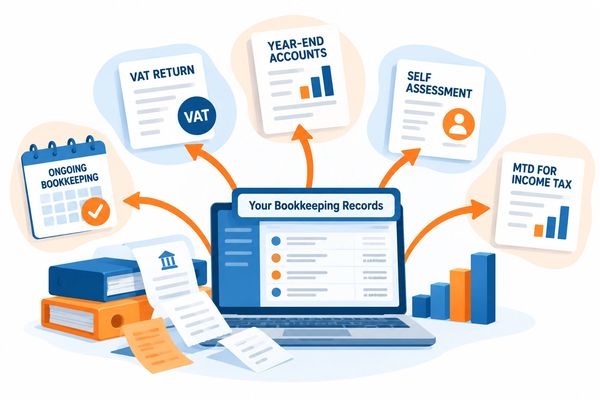
Your Records Support Other Accounting Obligations
Accurate catch-up bookkeeping can provide the foundation for:
- VAT Return preparation;
- year-end accounts;
- Self Assessment tax returns;
- Making Tax Digital for Income Tax;
- cash-flow monitoring;
- reviewing amounts owed by customers;
- checking amounts due to suppliers; and
- providing information to your accountant.
The catch-up service does not automatically include every related submission. We will confirm which services are included before beginning the work.

When the Catch-Up Work Is Complete
Once the agreed records have been brought up to date, we will explain:
- the period that has been completed;
- any information that remains outstanding;
- any balances or transactions requiring further attention;
- the next accounting or tax deadline, where relevant; and
- the practical steps needed to keep the bookkeeping current.
If another accountant will prepare your final accounts or tax return, we can help organise the bookkeeping information that needs to be provided to them.

Catch-Up Bookkeeping Works Best as a Partnership
We will bring bookkeeping knowledge, systems and organisation to the process. You know your business and can provide the information needed to understand its transactions.
The work progresses most effectively when:
- records are provided when requested;
- questions are answered promptly;
- relevant deadlines are shared with us;
- changes in the business are communicated; and
- both sides understand their responsibilities.
Working together helps us bring the records up to date accurately and build a more manageable bookkeeping process for the future.

We help you avoid another backlog
Once your bookkeeping has been brought up to date, we can move to an ongoing bookkeeping service if you would like us to continue looking after your records.
Where possible, we prefer to work on ongoing bookkeeping weekly.
You can send receipts and invoices through your data-capture tool as you receive them, while we keep the bookkeeping moving throughout the month.
This helps prevent another backlog from building up and gives you more current financial information throughout the year.